



Opioid Receptor
Opioid receptors are a group of G protein-coupled receptors with opioids as ligands. The endogenous opioids are dynorphins, enkephalins, endorphins, endomorphins and nociceptin. Opioid receptors are distributed widely in the brain, and are found in the spinal cord and digestive tract. Opioid receptors are molecules, or sites, within the body that are activated by opioid substances. Opioid receptors inhibit the transmission of impulse in excitatory pathways within the human body system. These pathways include the serotonin, catecholamine, and substance P pathways, which are all implicated in pain perception and feelings of well-being. Opioid receptors are further subclassified into mu, delta, and kappa receptors. All the classes, while exhibiting differing modes of action, share some basic similarities. They all are driven by the potassium pump mechanism, which is found on the plasma membrane of the majority of cells.
Opioid Receptor Isoform Specific Products
All Product Categories
-
Opioid Receptor Inhibitors
(23)
View all products
-
Opioid Receptor Agonists
(308)
View all products
-
Opioid Receptor Antagonists
(134)
View all products
-
Opioid Receptor Activators
(29)
View all products
-
Opioid Receptor Modulators
(27)
View all products
-
Opioid Receptor Controls
(7)
View all products
-
Opioid Receptor Ligands
(9)
View all products
-
Opioid Receptor Related Products (621)
Related Products (621)

-
Antibodies (3)
-
Opioid Receptor Isoform Comparison
-
3,4-Difluoro U-50488 hydrochloride
 0 ImagesCat. No.: HY-139390CAS No.: 1339332-99-83,4-Difluoro U-50488 hydrochloride is a utopioid.
-
Hodgkinsine B
 0 ImagesCat. No.: HY-N12180CAS No.: 586955-76-2Hodgkinsine B is an opioid receptor agonist and NMDA receptor antagonist, which has analgesic and anti-injurial effects. In addition, Hodgkinsine B has antiviral, antibacterial and antifungal activities.
-
Alvimopan (Standard)
 0 ImagesCat. No.: HY-13243RCAS No.: 156053-89-3Synonyms: ADL 8-2698 (Standard); LY 246736 (Standard)Alvimopan (Standard) is the analytical standard of Alvimopan. This product is intended for research and analytical applications. Alvimopan (ADL 8-2698) is a potent, selective, orally active and reversible μ-opioid receptor antagonist, with an IC50 of 1.7 nM. Alvimopan has selectivity for μ-opioid receptor (Ki=0.47 nM) over κ- and δ-opioid receptors (Kis=100, 12 nM, respectively). Alvimopan can be used for the research of postoperative ileus.
-
SR17018 (Standard)
 0 ImagesCat. No.: HY-111454RCAS No.: 2134602-45-0
-
2-Naphthyl U-47700
 0 ImagesCat. No.: HY-168820CAS No.: 67579-80-02-Naphthyl U-47700 is a utopioid.
-
AH 8507
 0 ImagesCat. No.: HY-W714509CAS No.: 41805-63-4AH 8507 structurally belongs to the opioid compounds and is an analog of AH 7563 (HY-W714505). However, AH 8507 does not exhibit significant analgesic effects in mice in both the phenylquinone test and the hot plate test, with ED50 values greater than 100 mg/kg.
-
3,4-Difluoro propyl U-47700
 0 ImagesCat. No.: HY-165021CAS No.: 2741276-45-73,4-Difluoro propyl U-47700 is a utopioid.
-
Trimebutine (Standard)
 0 ImagesTrimebutine (Standard) is the analytical standard of Trimebutine (HY-B0380). This product is intended for research and analytical applications. Trimebutine is a multi-target inhibitor and opioid receptor agonist with antimuscarinic activity. Trimebutine inhibits L-type Ca2+ channels and large-conductance calcium-activated potassium channels (BKCa channels), thereby inhibiting extracellular calcium influx and potassium ion efflux. Trimebutine also targets Toll-like receptors, inhibits Toll-like receptor 2/4/7/8/9 signals, and inhibits LPS-induced IRAK1 activation, as well as ERK1/2, JNK and NF-κB activation, thereby exerting anti-inflammatory effects. Trimebutine also induces tumor cell apoptosis by inhibiting the AKT/ERK pathway. Trimebutine also inhibits excessive contraction of smooth muscle and can be used in the study of gastrointestinal disorders such as irritable bowel syndrome (IBS).
-
JDTic dihydrochloride (Standard)
 0 ImagesCat. No.: HY-10487RCAS No.: 785835-79-2JDTic dihydrochloride (Standard) is the analytical standard of JDTic dihydrochloride (HY-10487). This product is intended for research and analytical applications. JDTic dihydrochloride is a potent antagonist of kappa-opioid receptors (KOR), blocking the κ-agonist U50, 488-induced antinociception.
-
DPI-287
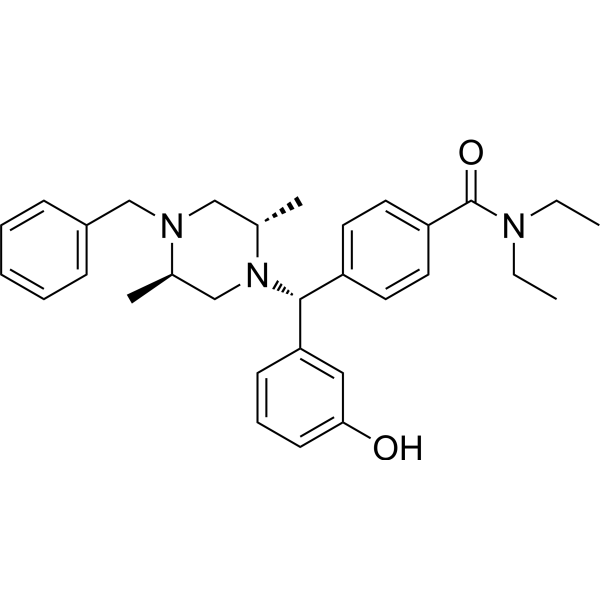 0 ImagesCat. No.: HY-156988CAS No.: 519058-13-0DPI-287 is a selective delta-opioid receptor (DOP) agonist with a Ki value of 0.39 nM and can be used for pain research.
-
Difelikefalin hydrochloride
 0 ImagesCat. No.: HY-17609ACAS No.: 2413256-25-2Synonyms: CR-845 hydrochloride; FE-202845 hydrochlorideDifelikefalin hydrochloride (CR-845 hydrochloride; FE-202845 hydrochloride) is an orally active peripherally acting kappa opioid receptor agonist. Difelikefalin hydrochloride reduces acute kidney injury, decreases oliguria, maintains urine flow, inhibits cytokine expression, and improves survival in endotoxemia after ischemia/reperfusion. Difelikefalin hydrochloride suppresses pruritus signals and exhibits neuromodulatory antipruritic activity. Difelikefalin hydrochloride can be used in research related to acute kidney injury, chronic kidney disease-associated pruritus, and atopic dermatitis.
-
Samidorphan hydrochloride
 0 ImagesCat. No.: HY-123689ACAS No.: 2328045-02-7Synonyms: ALKS-33 hydrochloride; RDC-0313 hydrochlorideSamidorphan hydrochloride is an orally active opioid system modulator that has a high affinity for binding with μ‐opioid, κ‐opioid, and δ‐opioid receptors. Samidorphan hydrochloride acts as an antagonist at μ‐opioid receptors and acts as a partial agonist at k-opioid and δ‐opioid receptors. Samidorphan hydrochloride primarily acts as an opioid receptor antagonist in vivo. Samidorphan can improve the behavior of depressed animals.
-
Samidorphan hydrochloride
0 ImagesCat. No.: HY-123689ACAS No.: 2328045-02-7Synonyms: ALKS-33 hydrochloride; RDC-0313 hydrochlorideSamidorphan hydrochloride is an orally active opioid system modulator that has a high affinity for binding with μ‐opioid, κ‐opioid, and δ‐opioid receptors. Samidorphan hydrochloride acts as an antagonist at μ‐opioid receptors and acts as a partial agonist at k-opioid and δ‐opioid receptors. Samidorphan hydrochloride primarily acts as an opioid receptor antagonist in vivo. Samidorphan can improve the behavior of depressed animals.
-
3,4-Difluoro isopropyl U-47700
 0 ImagesCat. No.: HY-165000CAS No.: 2752265-46-43,4-Difluoro isopropyl U-47700 is a utopioid.
-
Mianserin-d3 (hydrochloride)
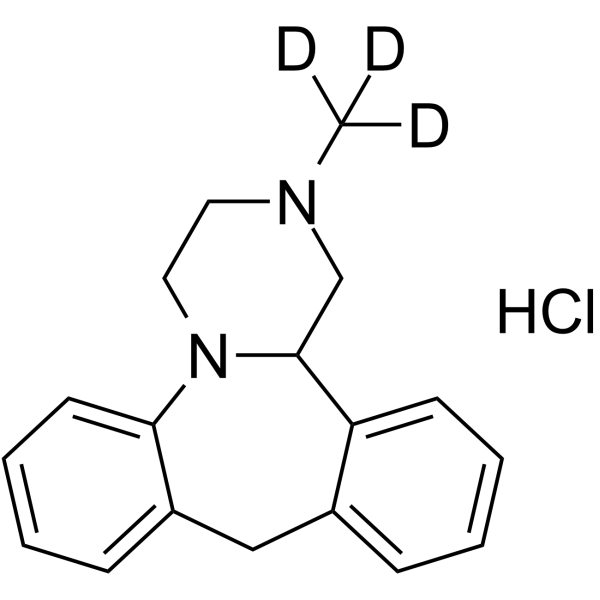 0 ImagesCat. No.: HY-B0188ASCAS No.: 1219804-97-3Synonyms: Org GB 94-d3Mianserin-d3 hydrochloride is the deuterium labeled Mianserin. Mianserin (Mianserine) is an orally active H1 receptor antagonist. Mianserin can activate κ-opioid receptor and octopamine receptor. Mianserin increases ERK1/2 and CREB phosphorylation, and antagonizes full κ-opioid agonist and Dynorphin A (HY-P1333)-induced MAPK phosphorylation. Mianserin modulates social and exploratory behaviour, raises electroconvulsive thresholds. Mianserin can be used for the research of neurological disease, such as depression and epilepsy.
-
Naloxone-d5
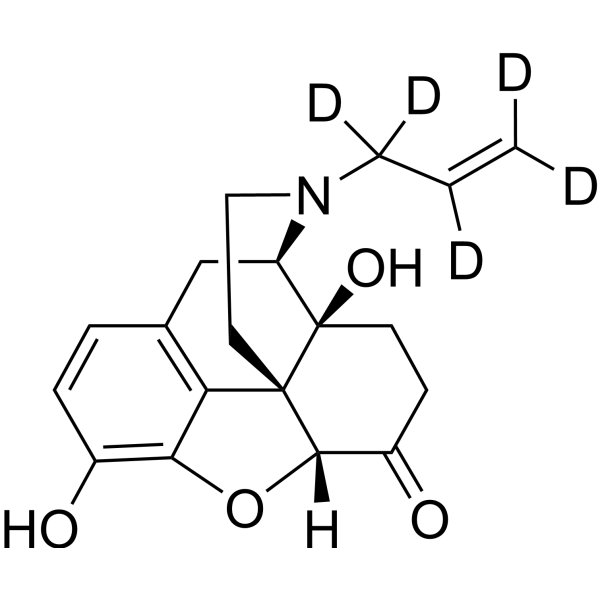 0 ImagesNaloxone-d5 is the deuterated-labeled Naloxone (HY-17417A). Naloxone is an orally active opioid receptor antagonist. Naloxone attenuates spinal cord stimulation‑associated anti‑hyperalgesic effects, antagonizes physiologic effects of endogenous opioid peptides linked to central nervous system injury sequelae, functions as a pressor agent to induce modest elevations in mean arterial blood pressure, exerts neuroprotective effects to improve post‑traumatic neurologic motor function, blocks opioid receptor‑mediated amnesic pathways, enhances memory consolidation, reverses Adrenocorticotropic hormone (ACTH) (HY-106373)‑ and epinephrine‑induced amnesia, and potentiates the memory‑facilitatory effects of ACTH and epinephrine.
-
U-49900
 0 ImagesCat. No.: HY-135521CAS No.: 67579-76-4U-49900 is a utopioid.
-
NOP agonist-1
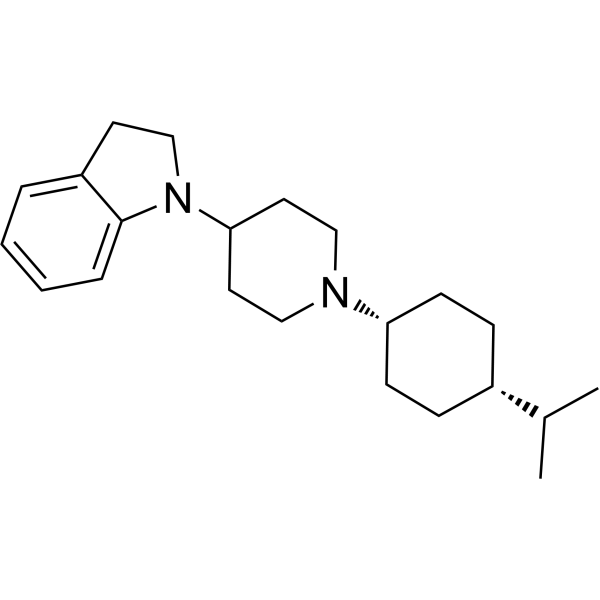 0 ImagesCat. No.: HY-156972CAS No.: 2099681-43-1NOP agonist-1(compound 4) is a nociceptin opioid receptor (NOP) partial agonist. NOP agonist-1attenuate parkinsonian disabilities in 6-OHDA hemilesioned rats.
-
Salvinorin A carbamate
 0 ImagesCat. No.: HY-130482CAS No.: 858345-57-0Salvinorin A carbamate is an agonist for κ-opioid receptor with an EC50 of 6.2 nM and a Ki of 3.2 nM.
-
Corynantheidine
 0 ImagesCat. No.: HY-N15180CAS No.: 23407-35-4Synonyms: (-)-CorynantheidineCorynantheidine ((-)-Corynantheidine) is a mu-opioid receptor (MOR) partial agonist that shows MOR-dependent analgesic effects in mice.




